
Posts

family sitting around elder

Benefits Of A Family Trust As Part Of My Estate Plan

Many people think trusts are for the affluent, but in actuality, family trusts are a powerful planning tool for individuals and families across the wealth spectrum.

We encourage you to carefully consider the differences between a will and a trust when crafting your estate plan. A will distributes assets outright upon your death. A trust allows you more customization and control over when and how your assets are distributed.

Here are a couple examples:

  • In a will, you can state that you’d like a certain sum of money to be given to each of your grandchildren. They will receive that sum upon your death. In a trust, you can state that your grandchildren only receive the sum once they turn 18 and that it may only be used for technical school or college tuition.
  • In a will, you can dictate that each of your children receive a portion of your assets. They will inherit those assets upon your death.
  • In a trust, you can control how and when the assets are received. For example, you can dictate in your trust that children receive payments in thirds after reaching the ages of 30, 35 and 40.
  • In a will, you might leave assets to a sibling. If that sibling is in a nursing home, the home could end up with your assets or they could kick your sibling off federal benefits. If you establish a trust, you can dictate that the assets will not be distributed if your sibling is in a nursing home or receiving Medicaid.

In This Article:

What Is A Family Trust?

Put simply, a family trust is a set of instructions that tell others what you want to happen to your assets after you’ve passed, and in some cases, while you’re still living.

A family trust is different from other types of trusts in that the beneficiaries are limited to family members, like a surviving spouse or children.

Whether a family trust is right for you will depend on your financial situation, your family’s unique needs and your goals.

How Does A Family Trust Work?

To protect, manage and distribute assets, there are three key roles.

  1. A grantor establishes the trust.
  2. A trustee (an individual or third-party fiduciary) manages the trust and makes decisions or hires someone to make decisions about investments, distributions and other financial matters. Trustees are bound by legal obligations to act in the best interest of the beneficiaries. They distribute assets or income generated from the trust’s assets to the beneficiaries based on the terms of the trust.
  3. Beneficiaries – in this case family members – benefit from the assets in the trust.

What Are The Types of Family Trusts?

There are two main types of family trusts: revocable and irrevocable.

Revocable family trusts are often used as living trusts to document how you want your assets to be managed and distributed both while you’re living and after you’re gone. They allow you to retain more control because you can change the trust’s terms at any time and can add or withdraw assets.

With a revocable trust, you can serve as trustee and name a successor trustee to take over when you are no longer able to. This can be especially helpful to your family if you reach a point in your lifetime where you become ill or are unable to manage your assets. Your successor trustee can make distributions on your behalf, pay bills, file tax returns and more.

An irrevocable family trust cannot be changed once created. It is often used as an estate planning tool to reduce estate taxes or protect assets from creditors.

There are many additional types of family trusts for specific purposes or benefits. Some common types include:

Testamentary trusts are created in the grantor’s will and take effect after he or she dies. They can be used to distribute assets to beneficiaries according to the grantor’s wishes and to help protect assets from creditors.

Special needs trusts help parents or grandparents ensure that children with disabilities have the financial resources they need to maintain their quality of life without jeopardizing their eligibility for government benefits.

Asset protection trusts help protect assets from creditors and lawsuits. They are often used by individuals and families at a high risk of being sued, such as business owners.

If you are considering setting up a family trust, an estate planning attorney can help you determine which type of trust is right for you.

They will evaluate your needs and goals to not only set up the trust, but also to maintain it properly over time.

What Are The Benefits Of A Family Trust Vs. A Will?

Family Trusts Avoid Probate

Having a will is better than having no plan at all; however, a last will and testament does not avoid probate. Probate is a court system designed to administer your will and pay creditors. All of the assets controlled by your will go through probate to be verified and distributed according to your wishes.

The probate court can be costly and time consuming. According to the AARP, the average estate will lose 5-10 percent of assets when administered through probate. For example, if you have a five hundred thousand dollar estate, at a minimum, you’re going to spend twenty-five thousand dollars administering it through probate.

Not only is it costly, but also it is time consuming. The minimum time to administer a will in probate court is six months, but the average time in most counties is eleven months.

If established properly, a family trust can transfer assets to your heirs while avoiding probate. There will be no probate fees and no no minimum administration time.

Family Trusts Minimize Federal or State Taxes

Without a family trust, an individual who finds themselves over the federal exemption limit could face 40-45% in estate taxes. A family trust can significantly reduce or eliminate these taxes by allowing a surviving spouse to make certain tax elections. This is commonly known as “marital deduction planning.”

A family trust allows the surviving spouse to set aside a portion of the estate, including the growth, tax free. For example, if the federal exemption were $1 million, and a surviving spouse is left with $5 million, with the trust, he or she could set aside $4 million in trust and the entire balance (including growth) after the death of the second spouse, would be tax free. Without the trust, the heirs would be paying 40% on $4 million in estate taxes.

Family Trusts Protect & Preserve Your Assets

If you have minor children, then establishing a family trust becomes a must. A minor child cannot legally inherit your assets.

Family trusts provide asset protection by holding assets in trust for your children’s benefit. Even when your children become adults, the trust still provides asset protection against creditors, litigation, and divorce. For example, if you passed away leaving a large sum to your forty-five-year-old child who has spending issues, a pending litigation, or a divorce in process, the trust would hold the assets until your child is in a better place in life.

Another common asset protection measure occurs when individuals are in their second marriage. In this scenario, there is nothing preventing the remaining spouse from disinheriting children from a prior marriage. For example, a husband and wife in their second marriage care for two children the wife has from her prior marriage. The wife passes away and leaves everything to her husband, and the contingent beneficiaries are her two children. Five years later, the husband remarries and creates a new estate plan naming his new spouse as primary beneficiary of his estate and his two step-children as contingent beneficiaries. When the husband dies, the new spouse inherits everything and the children are accidentally or intentionally disinherited.

Family Trusts Offer Privacy

When you go through probate, all of your information – assets, beneficiaries and more – become public record. Establishing a trust will allow you to avoid probate and maintain your privacy.

Family Trusts Are Cost-Efficient

Having a trust is more cost- effective than a will. Because the trust allows you to avoid 6-18 months of probate costs, more of your legacy is preserved for your family.

How Do I Set Up A Family Trust?

The exact process varies, but the following are key steps that your family trust attorney will walk you through.

  1. Decide what assets will be placed in your trust. While you might already have an idea of what you’d like to include, your attorney may help you uncover some additional assets that would benefit from being placed in a trust. Assets can range from cash and investments to real estate and other property.
  2. Choose your beneficiaries. They might include your spouse, your children, grandchildren or other close family members.
  3. Establish the rules of your trust. For example, will assets be distributed with age requirements or terms for how the assets may be used?
  4. Determine who will manage the trust. The manager of the trust, called the trustee, could be yourself, someone you know or a third party, such as a financial institution.

Once you are confident in these decisions, your family trust attorney can draft the trust document.

To learn more about how to set up a family trust with Baron Law or to schedule a free consultation, call 216-573-3723 or submit your request online.

Baron Law Cleveland

Estate Planning – Documents I Should Provide My Attorney

Cleveland, Ohio, estate planning lawyer, Daniel A. Baron, Ohio, offers the following information on what documents are necessary for you to provide your attorney when sitting down to establish your comprehensive estate plan.

“Be prepared.” Boy Scouts of America

A recent survey taken by the AARP found that 3 out of every 5 Americans have no estate-planning documents, not even a simple will. Thus, money and assets they’ve spent a lifetime earning and saving are at risk from creditors, litigation, and state and federal taxation. Further, none of their friends or family know how to handle their affairs or last wishes. Even though the majority of people have not taken the necessary steps to formulate a plan when the inevitable comes, all can agree that leaving friends and family to scramble to pay your debts, settle your accounts, and divide your worldly possessions is not the best way. A time of mourning should be just that, for mourning, not for calling bankers, insurance agents, or accountants.

Hopefully, you’ve decided to take the first step and enter into the minority of Americans who proactively address what is left behind when they pass. However, a familiar question exists, how do I get started? That is, what do I need to start planning my estate?

Most, if not all, lawyers are traditional, they like things they can touch and read. So, before you meet with your attorney to plan your estate, you’re going to want to bring a few things. The following list is by no means exhaustive but will give you a good start. Collecting these documents before your meeting will save everyone time, allow your attorney to better comprehend your personal estate planning needs, and prepare you mentally so you can better communicate what you want and what your family needs out of your estate plan.

A General Accounting of your Estate

The word estate is a term that denotes all of the money, property, and debts owned by person, particularly at death. Naturally in order to plan an estate, it must be known what an estate actually encompasses. Therefore, on a piece of paper or computer spreadsheet, your going to write out your estate.

List out: your taxable accounts, your retirement accounts, any life insurance policies, any annuities, your personal residence, other real estate, any highly significant personal property (cars, furniture, artwork, jewelry, etc.), business interests, and any outstanding debts, liabilities, or obligations. For each category, split them up between those owned solely by you, those owned solely by your spouse (if married or part of a civil union), and those owned jointly.

This information is critical for tax projections and allows your attorney to take the necessary steps now, or at death, to ensure that the most property and money goes to where you want and not lost via government taxation, creditors, or litigation. There is a multitude of ways your attorney ensures estate preservation, however, knowing exactly what you have and what you want to do with it is critical. Note that this list only serves as an estimate of your estate, not an exact accounting. Your attorney will be able to advise and guide you on obtaining an accurate picture of your entire estate but this list will be the foundation for future calculations.

Life Insurance Policies

Life insurance is a common tool people use to guarantee their surviving family won’t be left in an untenable financial position in the event of death. The lump sum that life insurance proceeds guarantee can fill critical gaps in an estate plan and ensure that your loved ones are taken care of and your affairs are handled in a respectable manner. This is only possible, however, if the proper beneficiaries are designated. If not, who knows how your proceeds are spent. Therefore, ensuring the proper beneficiaries are denoted and/or updated on your insurance policies is of utmost importance. Make sure to have your attorney review your beneficiaries and file any change of beneficiary forms you desire.

Of further note for seniors, some life insurance policies, such as whole life or universal, accrue cash value which may affect Medicaid eligibility. The accumulation of cash value under particular life insurance policies counts as an asset, which if exceeds $2,000 may disqualify a person from Medicaid. Again, this is something to bring to your attorney’s attention so your estate plan can be more personalized to your needs.

Additionally, life insurance policies are often part of your taxable estate. As such, proper steps during estate planning must be undertaken to lower or avoid the tax burden on the estate. Named beneficiaries of life insurance proceeds may also face significant tax consequences from a sudden influx of cash. As such, bringing your life insurance policies to your estate attorney allows him to understand the type of insurance you possess and avoid issues with regard to beneficiary designations, Medicaid eligibility, and estate tax consequences.

Investment Portfolio

You’re also going to bring your investment portfolio to your attorney. That is, anything evidencing your 401k, owned annuities, stocks, bonds, or mutual funds, and other retirement accounts such as IRAs and Roth IRAs, regardless of whether the IRS classifies them as qualified or unqualified plans. Your investment portfolio is likely a major asset that is a significant part of your taxable estate and whose constituent parts each often have their own special rules regarding contributions, distributions, transfers, and inheritance. Bringing your investment documents to your attorney will allow him to plan your estate accordingly and inform you of the special rules, privileges, and schedules applicable to the particular investment instruments you’ve chosen.

A List of Important Property with Bequests

Generally, this is what most people think of when talking estate planning, who gets the house and who gets grandma’s heirloom necklace. In order to avoid any conflict and confusion between surviving family members over who gets what when you pass, write out a list of the biggest and most important bequests of personal and real property.

Most people list out vehicles, real estate, business interests, family heirlooms, expensive electronics, art work, etc. Pretty much anything that has high sentimental or financial value. Obviously for each item on the list write who gets what and in what way. For simple property, like jewelry, usually an individual gets a direct bequest and the item is theirs when you pass. For other property, such as real estate or business interests, usually these are split up in particular ways. For example, a business being split equally between surviving children or a house passing only to children of a first marriage. Your attorney will inform you of the multitude of ways bequests may be structured in order to satisfy your particular estate planning needs.

Thinking about and writing out your property bequests ensures your final wishes are followed and avoids familial infighting. On top of bringing this list to your attorney, bring any deeds, titles, or other ownership documents. This will expedite an estate accounting after your death for your executor and makes sure you actually own what you think you do. Far too many times families are taken by surprise by a faulty title or hidden lien or claimant on a deed. Your attorney can easily check a chain of title or confirm the validity of a deed and avoid any question of ownership down the line.

A “Managed Care Plan”

This is not to be confused with the private insurance plan you sign up for, or Ohio picks for you, when you apply and are approved for Medicaid. Managed care plans within the context of Medicaid private insurance isn’t the subject here, however, it is an important subject that should be discussed and planned for with your attorney.

Within this context, your managed care plan means a coherent idea of where and how you want to spend the last years of your life, especially in the event of deteriorating health or debilitating disease. That is, the logistics, finances, and questions surrounding issues of hospice care, managed care facilities, nursing homes, and general living as one advances in age.

For example, planning out your senior living situation will likely enable you to stay with your primary care physician and specialists longer. Often the accessibility of physicians and medical specialists are subject to geographic restriction, insurance coverage, or out-of-pocket cost. A proper estate plan can guarantee the funds exist to support continued care in the manner you’ve grown accustomed to and communicate to friends and family your medical wishes far in advance of when those questions arise. Never underestimate the value of spending the autumn of your years in clean and comfortable healthcare facilities with treatment from doctors that have an established relationship. As such, bring any contracts, agreements, or marketing materials of any health or senior living facilities you wish to go to. Every piece of information allows further personalization of your estate plan and more clearly communicates what you want to your family many years down the road.

Further, bring important legal documents such as designations for durable, health, or financial powers of attorney, any do not resuscitate orders (DNRs), and executor and administrator elections. If you don’t have any of these documents prepared, these can easily be drafted by your attorney during your estate planning.

Americans are living longer than ever before and having a plan to confront advancing age is important to ensure comfortable living and piece of mind for the family. Granted this is not an enjoyable or fun aspect of life to think about and plan out, but it is something you and your family will never regret.

Conclusion:

Bringing the listed documents and gathering up your thoughts according to the issues highlighted will give you a good head start in preparation to planning your estate with your attorney. Again, this list is not exhaustive and only touches on a fraction of the issues that addressed during estate planning. Major issues such as surviving spousal support and guardianship of minor children, among many others, must be handled too, so think about these issues as well. Estate planning is a complex process but taking a little time to gather documents and think about the future will pay big dividends to you while you’re here and make life much easier for your family when you’re not.

You don’t have to be rich to protect what you’ve spent a lifetime trying to build. To find out whether a trust is right for your family, take the one-minute questionnaire at www.DoIneedaTrust.com. There are a number of different trusts available and the choices are infinite. With every scenario, careful consideration of every trust planning strategy should be considered for the maximum asset protection and tax savings.

For more information, you can contact Dan A. Baron of Baron Law LLC at 216-573-3723. Baron Law LLC is a Cleveland, Ohio area law firm focusing on estate planning and elder law. Dan can also be reached at dan@baronlawcleveland.com.

Helping You and Your Loved Ones Plan for the Future.

About the author: Mike E. Benjamin, Esq.

Mike is a contracted attorney at Baron Law LLC who specializes in civil litigation, estate planning, and probate law. He is a member of the Westshore Bar Association, the Ohio State Bar Association, the Cleveland Metropolitan Bar Association, and the Federal Bar Association for the Northern District of Ohio. He can be reached at mike@baronlawcleveland.com.

Disclaimer:
The information contained herein is general in nature, is provided for informational and educational purposes only, and should not be construed as legal or tax advice. The author nor Baron Law LLC cannot and does not guarantee that such information is accurate, complete, or timely. Laws of a particular state or laws that may be applicable in a given situation may impact the applicability, accuracy, or completeness of the preceding information. Further, federal and state laws and regulations are complex and subject to change. Changes in such laws often have material impact on estate planning and tax forecasts. As such, the author and Baron Law LLC make no warranties regarding the herein information or any results arising from its use. Furthermore, the author and Baron Law LLC disclaim any liability arising out of your use of, or any financial position taken in reliance on, such information. As always consult an attorney regarding your specific legal or tax situation.
“He who is always his own counselor will often have a fool for his client.” Old English Proverb est. circa 1809.
Baron Law Cleveland LLC

What Is An Estate Plan, Part I – Death Documents?

Baron Law LLC, of Cleveland, Ohio, offers the following information on different components of an Estate Plan.  To see what plan is best suited for your needs, contact Baron Law, LLC, Cleveland, Ohio.

By failing to prepare, you are preparing to fail.” Benjamin Franklin

Estate planning is a concept that many people know about, but few fully understand. To most, planning an estate consists simply of establishing a trust or drafting a will. Granted, these are indispensable aspects but such a limited view only serves to handicap successfully preparing for impending mortality.

Aside from ensuring assets pass to heirs and designated assets are freed from probate, a comprehensive estate plan can address a innumerable issues and provide effective solutions. Estate plans may be tailored to provide consistent income for retirement, guarantee responsible individuals are in place in moments of crisis, and medical wishes are communicated and followed. At the end of the day, however, an estate plan is simply a collection of legal documents. Each legal document has a specific purpose, possesses particular advantages, legal conventions, and applicable situations. Nevertheless, most estate plans do consist of a “core” of legal documents that are often advantageous to have regardless of health or financial situation. An estate attorney will draft the documents critical for a given situation but the following is a list of the “core” legal documents that will likely make up any estate plan.

The following consists of the typical documents within a traditional estate plan and is by no means exhaustive. Estate plans are reflective of their owners and are tailored specifically to that person or couple and the needs of surviving family members and financial interests. Again, an attorney is in the best position to advise and guide you on what the major estate planning concerns are and the best legal methods to take. This part of a two-part series discusses the estate planning documents largely concerned with providing instructions in the event of death.

Last Will and Testament

A last will and testament is the document most people associate with estate planning. The will memorializes the “last wishes” of a decedent and guides surviving friends and family on how to split up an estate according to the beneficiary designations and instructions present in the document. There are many types of wills and each one is drafted uniquely for the individual and their estate.

Though wills are specifically created, all share important uses and common characteristics. Again, wills bequest particular money and assets to chosen friends and family. Further, they provide for the how and when such bequests will take place. Some instruct money only to be given on an 18th birthday or only between children of a first marriage. Of critical importance, wills are also the primary method of election of guardians for minor children or disabled familial charges and executors of the estate. The provision of guardianship, a clear plan for property distribution post death, and executor election are the primary incentives for drafting a will. Addressing all is an utmost necessity for ensuring peace of mind for those left behind.

Wills, with some exceptions, all possess the same legal conventions controlling their creation. The point of these legal rules is to ensure the legitimacy of the will, the authenticity of the last wishes evidenced by the document, and protect estates from predatory practices and opportunists. Generally, a legally operative will must be in writing, signed by testator of sound mind, and witnessed by two competent witnesses.

While most estate assets are covered under a will, some assets are not. The following are an example common asset outside of a will, also sometimes referred to as non-testamentary assets: retirement accounts, life insurance proceeds, and property owned jointly with right of survivorship. Non-testamentary assets are normally bequeathed by independent beneficiary designations within the documents of creation or on associated accounts. As such, these assets normally do not undergo probate and are available to beneficiaries much quicker than assets passed via a will and the longer probate process. Distinguishing between testamentary and non-testamentary assets can have critical tax consequences for an estate, as such, please consult an estate attorney for guidance.

Wills are a mainstay and common tool for estate planning, however, its drafting can rapidly grow in complexity due to a convoluted family structure or an expansive estate. Again, an attorney should be retained to draft a will thus ensuring last wishes are effectively communicated and legally valid within a probate court. Failure to draft a will or an improperly drafted or implemented one may result in assets going to improper parties, an undesired executor administrating an estate, irresponsible or unknown guardians for minor children, or undue legal fees and court costs.

Guardianship Designations for Minor Children

A critical concern for most people with young children is, who is going to take care of my children if I’m not here? Ensuring that financially stable friends or family willing to raise children exist affords piece of mind to parents in the event of sudden or unexpected death. Also, proactively addressing guardianship lets parents pick like-minded guardians in regards to personal, lifestyle, or religious views so surviving children are still, at least partially, raised in the manner they desire.

The easiest way to designate a guardian is to name that person or persons in the last will and testament. Then upon death, if the children are not yet 18, a probate court in most situations will appoint the named individuals as guardians according to the specified instructions. A simple will guardian designation, however, may not be convenient or appropriate in certain situations. Family compositions often change, such as in divorce or estrangement, or previously nominated guardians pass away thus negating the express wishes within a will. As such, amending or redrafting a will every time a different guardian is preferable can be time consuming and expensive.

Another way, however, exists to appoint a guardian outside of a will. An independent writing, other than a durable power of attorney, signed, witnessed, notarized, and filed with the appropriate probate court, specifying an appropriate guardian, is sufficient to convey such responsibilities. This method is relatively inexpensive and affords more flexibility to concerned parents. This independent writing method is not meant to affect any other issue or provision within a last will and testament other than appointment of guardians in the event of death. Note, an attorney will be able to resolve and watch for any potential issues regarding contradictory guardianship designations in separate estate planning documents.

Unfortunately, not everyone is blessed with a stable home life or responsible extended family. As such, proper guardian designation documentation is important and alleviates stress for parents, especially within the context of debilitating disease or deteriorating health. Further, appropriate designation avoids the involvement of child services and the courts in determining custody, eliminates the prospect of child trauma and stress upon children and concerned family during transition, and ensures surviving children have no opportunity to become wards of the state.

Letter of Intent

The aforementioned documents taken together serve to mostly illustrate and communicate a decedent’s final wishes. Everything, however, is subject to interpretation. Take the phone game most people played as children for example. A message begins at one end of a chain and, through repetitive communication and subtle shifts in language and understanding, comes out at the end completely different than how it started. A letter of intent fills in any gaps in understanding and prevents manipulation, subtle or overt, of estate instructions.

A letter of intent is a simple document that provides comprehensive instructions for what the decedent views is the most critical information and desired outcomes of an estate plan. The letter, however, is an informal document that is not legally binding upon a probate court. That being said, courts generally rely on them during probate proceedings because there is no greater authority than a decedent’s own words. After all, the entire point of probate is to distribute estate assets as close to a decedent’s intent as possible after the fact. Common instructions within a letter of intent include: guardian designations for minor children, if not detailed in a last will and testament, specific methods for bequests, the location of assets, funeral details, and the locations of estranged family members or friends chosen as beneficiaries. A decedent’s letter of intent in an additional effort to eliminate any confusion or room for interpretation within an estate plan.

Further, a letter of intent may serve as an alternative to adding on to an existing will independent of a codicil. Again, the letter itself is not legally binding like a codicil would be but it is relatively inexpensive, quick, and may serve as a viable substitute in a crunch. In Ohio, codicils are governed by strict legal conventions while letters of intent are not. As such, letters may be the document of last resort in situations of impending mortality or incapacity. As most probate judges agree, something is better than nothing. Note, however, a letter of intent is never a substitute for a will. Always consult with an attorney regarding how to best utilize a letter of intent in conjunction with other estate planning documents.

Your last will and testament, guardianship designations, and letter of intent are all critical estate planning documents, however, taken together they only offer partial protection and primarily focus on providing instructions after death. In the next part of the series the estate documents of the living will, HIPPA authorization, and healthcare and durable powers of attorney, which concentrate on providing instructions during life, are explored. Taken together, all the documents explored during this series can provide comprehensive protection for the most critical issues of both life and death.

You don’t have to be rich to protect what you’ve spent a lifetime trying to build. To find out whether a trust is right for your family, take the one-minute questionnaire at www.DoIneedaTrust.com. There are a number of different trusts available and the choices are infinite. With every scenario, careful consideration of every trust planning strategy should be considered for the maximum asset protection and tax savings.

For more information, you can contact Mike Benjamin of Baron Law LLC at 216-573-3723. Baron Law LLC is a Cleveland, Ohio area law firm focusing on estate planning and elder law. Mike can also be reached at mike@baronlawcleveland.com.


Helping You and Your Loved Ones Plan for the Future.


About the author: Mike E. Benjamin, Esq.

Mike is a contracted attorney at Baron Law LLC who specializes in civil litigation, estate planning, and probate law. He is a member of the Westshore Bar Association, the Ohio State Bar Association, the Cleveland Metropolitan Bar Association, and the Federal Bar Association for the Northern District of Ohio. He can be reached at mike@baronlawcleveland.com.

Disclaimer:
The information contained herein is general in nature, is provided for informational and educational purposes only, and should not be construed as legal or tax advice. The author nor Baron Law LLC cannot and does not guarantee that such information is accurate, complete, or timely. Laws of a particular state or laws that may be applicable in a given situation may impact the applicability, accuracy, or completeness of the preceding information. Further, federal and state laws and regulations are complex and subject to change. Changes in such laws often have material impact on estate planning and tax forecasts. As such, the author and Baron Law LLC make no warranties regarding the herein information or any results arising from its use. Furthermore, the author and Baron Law LLC disclaim any liability arising out of your use of, or any financial position taken in reliance on, such information. As always consult an attorney regarding your specific legal or tax situation.

Baron Law

The Marital Deduction – What are the benefits?

Cleveland, Ohio estate planning attorney, Daniel A. Baron, offers information on The Marital Deduction as well as other Tax Planning Advice and what to make part of your Estate Planning.

What are the benefits?

The most important deduction a married couple has is the The Marital Deduction.  The amount of assets which can be passed upon death from one spouse to the other is unlimited and is also used to defer ALL estate taxes until the surviving spouse passes.  Current tax laws allow one spouse to give the other spouse assets where there is little to no tax imposed upon the transfer of these assets.  No matter what the value of the assets which are being transferred, whether it is $50,000 or $50,000,000.

What if there is a divorce?

If you happen to be divorced from your spouse, you can still pass assets to the ex-spouse after you pass with little or no tax being imposed if it is stated in the divorce decree.

My spouse is not a U.S. Citizen – Do the same tax laws apply?

The Marital Deduction is unlimited as long as both spouses are U.S. Citizens. So what happens when one of the spouses is not a US Citizen?

Should the first spouse to pass away be a U.S. Citizen and the surviving spouse a noncitizen of the U.S., unfortunately the unlimited marital deduction for Federal Estate Taxes is not available.

However, the taxes can be deferred by setting up a Qualified Domestic Trust (AKA QDOT), and having the assets pass through this specialized trust.

Should you own real property, consider adding this to the trust as the taxes will be deferred until the noncitizen spouse passes away.

For more information on The Marital Deduction and implementing other tax savings ideas as part of your Estate and Tax Planning, contact Daniel A. Baron of Baron Law to maximize tax savings upon your passing.  Contact us today at 216-573-3723.

Estate Planning Attorney

What Recourse Do I Have if My Power of Attorney is Stealing From Me?

Cleveland, Ohio estate planning attorney, Daniel A. Baron, offers the following helpful answers to Powers of Attorney:

Can the Power of Attorney be used by the agent to take my money or property without my permission?

Unfortunately, you can run the risk that the agent you choose to give your Power of Attorney could abuse the power by spending your money or taking your money without your knowledge or worse without your permission. Because the agent can use the Power of Attorney to access your bank account and sell your property, it is prudent  that you not give your Power of Attorney to anyone you do not trust.  If you happen to have an unscrupulous agent, it can be very challenging to get back funds or property taken by the agent, because the agent usually has no money left to return as they have used it all for their benefit.  The person acting as your Power of Attorney has the power to sell your property, or mortgage it.  It cannot be stressed enough that you chose your Power of Attorney very wisely.


If I think someone is using my Power of Attorney to steal from me, what can I do?

If you are suspicious that your agent is abusing their powers, revoke the Power of Attorney immediately.

Next, without delay, notify all banks, brokerage firms, or other financial institutions in which you have money that you have revoked the Power of Attorney.

Finally, go to the probate court. You may either by yourself or through an attorney.  Demand that the agent you suspect of absconding with your funds file a detailed account showing how your money was spent. A filing fee will need to be paid by you and you may need to possibly pay the agent for the cost of preparing the accounting documentation. Next, the court will hold a hearing at which time you can challenge the any or all of the information given in the detailed accounting. Ultimately, if the court finds the agent took your money without your authorization, you can sue the agent and/or possibly press criminal charges.


Can I revoke my Power of Attorney?

The Power of Attorney cannot be used unless the agent has it or it, or at least a copy and either you or they have given to banks, financial institutions, or others so that they think you want the agent to act on your behalf. If you have not given the Power of Attorney to anyone, you can revoke it by destroying the document.

If the eventuality the Power of Attorney has been given to the agent, an institution, or has already been recorded, you should execute immediately a revocation of the Power of Attorney that is witnessed and acknowledged in the same manner as the first Power of Attorney. Then; just as you distributed the Power of Attorney initially, you will need to furnish a copy of the Revocation to the banks, brokerage firm, or any other financial institution, and anyone else that may have a copy of the original Power of Attorney form that they know the Power of Attorney is no longer valid.

A Power of Attorney is only one of the many parts to a comprehensive estate plan. For information regarding living wills, trusts, power of attorney, or a pour-over will, or further questions on Powers of Attorney, contact Daniel A. Baron of Baron Law today at 216-573-3723.


Estate Planning Attorney

What Is a Power of Attorney and Do I Need One?

Cleveland, Ohio estate planning attorney, Daniel A. Baron, offers the following helpful answers to Powers of Attorney:

What is a Power of Attorney?

A Power of Attorney is a legal document you use allowing another designated person, of your choosing, to act on your behalf. It is a legal relationship in which you are the principal and the person you appoint is the agent.  A Power of Attorney outlines specific powers you give to your agent. The powers can be limited or broad. An example would be, you are selling your house, but are not able to attend the closing.  You can at that point give someone the power just to sign the deed in your absence.  Keep in mind that most durable powers of attorney, give your agent the power to do almost anything you could or would do.  In this example you may just limit the function of the Power of Attorney’s duties.

Some financial institutions, brokerage firms, or banks may require you to sign one of their own company specific Power of Attorney for their files.

Why do I need a Power of Attorney?

In the event you become unable to handle your own affairs as a result of illness, accident, or even being absent due to your job, the Power of Attorney gives your agent the power to handle your financial affairs as you would handle them yourself.  Since you might not be able to execute a Power of Attorney at a time when you are disabled due to an accident or become incapacitated, or should you become unable to handle your own affairs and have no Power of Attorney, your spouse or family may have to request the Probate Court to appoint a power of attorney on your behalf.  A Power of Attorney can be very helpful to both you and your family, as by naming your own agent and having a signed Power of Attorney avoids the expense of probate court and avoids naming someone who may not know and carryout your wishes.

Where should I keep my Power of Attorney?

As your Power of Attorney is an important legal document, it is recommended that you keep it in a safe and secure place. You may also want to give a copy to your agent(s) or in a safe and secure place where it can be easily found by your acting agent.  Your agent may also keep a copy in case yours is lost. It is also wise to make sure your family knows where to find your Power of Attorney, or whom to ask when it is needed.  And of course, your attorney will have a copy of the Power of Attorney.

What does “durable” mean?

The legal definition of ‘durable’ means the Power of Attorney will remain in effect even if the principal becomes mentally incapacitated. The powers you give to your agent will remain effective even though you are unable to give your agent updated instructions.  If you have an older power of attorneys or an out of state powers of attorney, many of these still have these words, and remain in effect.

When does the Power of Attorney take effect?

The Power of Attorney becomes effective immediately upon signing the document before two witnesses and having it notarized. The agent is able to use the Power of Attorney as soon as he or she receives it.  However, you may give the Power of Attorney to your agent(s) and tell the person(s) NOT to use it unless you are unconscious or unable to act for yourself.  It is imperative that you know and trust the person you are asking to be your Power of Attorney.

You may opt to use a “springing” Power of Attorney which would not take effect until a specific triggering event happens, such as you become incapacitated. However, there are several issues with springing Powers of Attorney.  The agent first needs an affidavit showing the triggering event has occurred before the Power of Attorney can be put into use.  Then, even though the law says banks and other institutions that accept the document with the affidavit are not liable, banks have been reluctant to recognize the agent’s power under a springing Power of Attorney. Ultimately, it isn’t clear whether such a document would be accepted in other states other than your own.

Does giving someone a Power of Attorney mean I don’t have control over my money any longer?

It does not. Although you still have the right to control your money and property after a Power of Attorney has been put in place, keep in mind, you are giving your agent the ability to access your money.  Although there is a risk that a dishonest or unscrupulous agent might steal your money, your agent is not supposed to use your funds in any manner with your permission.  It is therefore vital to choose an agent you trust. A sound idea would be to go over the agent’s duties before you sign your power of attorney.

Do I need to update my Power of Attorney if nothing has changed?

It is always a good idea to review your Power of Attorney periodically to make sure you still agree with your choices.

There are some banks, brokerage firms, and other financial institutions that will attempt to reject a Power of Attorney that is several years old. This is mainly due to the possibility that the Power of Attorney has been revoked.  This is a good thing, so that an unscrupulous agent that had their Power of Attorney duties revoked, does not gain access to your funds and deplete them.  There are several options to prepare for this. If you remain competent it is very wise to re-execute your Power of Attorney every five years or so.

If unfortunately, you are no longer competent; your agent can sign an affidavit that your power of attorney is in full force and in effect and provide that to the financial institution.

A Power of Attorney is only one of the many parts to a comprehensive estate plan. For information regarding living wills, trusts, power of attorney, or a pour-over will, or further questions on Powers of Attorney, contact Daniel A. Baron of Baron Law today at 216-573-3723.

estate planning attorney

Testamentary Trusts

Cleveland, Ohio Estate Planning Attorney Dan A. Baron offers the following on Testamentary Trusts.

Testamentary trusts are a great way to plan and safeguard your assets for minor children.  In other uses testamentary trusts can be used for beneficiaries with addictions or disabilities.   Unlike most trusts, testamentary trusts are incorporated into your last will and testament and are funded only after the creator’s death.   The biggest reason people use testamentary trusts is because they are able to control their assets after they die.

For example, if Mom and Dad die in a car accident leaving behind two young children, they would not want their $500,000 estate being left in the hands of nine and ten-year old.    Instead, Mom and Dad create a last will and testament and incorporate language that appoints a guardian for the children and trustee of their testamentary trust.   The trust parameters outlined for the Trustee to follow often include broad language like “to provide for the health, education, and well-being of my children.”   The trustee controls the money and then distributes it to the children as they need it.  Most often, the remaining balance left in the trust is distributed to the children once they reach the age of 25.

It’s important to remember that unlike most trusts, testamentary trusts do not avoid probate.  Instead, testamentary trusts are created after the probate process is complete.  Assets left from probate fund the trust and the trustee is then responsible for carrying out the wishes of the deceased.  Once the assets are in trust, they are protected from creditors and litigation.  However, there is no asset protection for the creators before death.

To learn more about testamentary trusts and how they might be beneficial for your estate plan, contact Baron Law LLC today at 216-573-3723.  You will speak directly with an attorney who can assist you.


The information contained in this article is provided solely for convenience purposes only and all users thereof should be guided accordingly. This article is not meant to provide legal advice. If you wish to receive a legal opinion or tax advice on the matter(s) in this report please contact our office and we will speak with you directly. 


lawyer in cleveland ohio

What is a Charitable Remainder Trust?

Unique Estate Planning Methods to Secure a Lifetime of Income, Save Taxes, & Benefit the Community

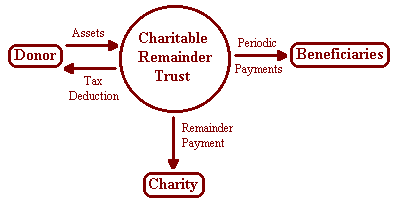
Most people planning for their retirement have a misconception that charitable giving is only for the wealthy.  However, there are several estate planning tools that can benefit your favorite charity while also earning you steady stream of income.  One of these tools is known as a charitable trust remainder, or “CRT.”  A CRT lets you convert a highly appreciated asset like stock or real estate into a lifetime of income. It reduces your income taxes now and may also reduce your estate taxes when you die. When the assets are sold, creators of the CRT escape the ever-daunting capital gains tax.  But best of all, a charitable remainder trust allows you help one or more of your favorite charities.

How does a CRT work?

Creators of a charitable remainder trust transfer an appreciated asset into an irrevocable trust.  It’s important to have assets that appreciate in value in order for a CRT to work effectively.  Assets that have little or no appreciation may be better off going into a charitable lead trust or charitable remainder annuity trust.  In any event, when you transfer an appreciating asset into the charitable remainder trust, it removes the asset from your estate.  Thus, no estate taxes will be due on it when you die.  Most importantly, you also receive an immediate charitable income tax deduction.

After the trust is created, the Trustee sells the asset at full market value.  Again, after the sale you will not pay capital gains tax.  The money is then reinvested and the proceeds from the reinvestment go to you for the rest of your life.  When you die, the remaining trust assets go to the charity(ies) you have chosen.  Hence the name charitable remainder trust.

attorney in cleveland, ohio

Cleveland, Ohio estate planning attorney

Example Using a Charitable Remainder Trust

Let’s say for example that Gail Giver (age 63) purchased some stock for $100,000.  It is now worth $500,000.  She would like to sell it and generate some retirement income.  If she transfers the stock to a CRT, Gail can take an immediate charitable income tax deduction of $90,357. Because she is in a 35% tax bracket, this will reduce their current federal income taxes by $31,625.

The trust is exempt from capital gains tax so when the trustee sells the stock for the full $500,000, all of the money is available for reinvestment.  Assume that the assets will accumulate 5% of annual growth and Gail is expected to live for another 26 years.   Using this information, that produces $25,000 in annual income which, before taxes, will total $650,000 over Gail’s lifetime. And because the assets are in an irrevocable trust, they are protected from creditors.

Example Not Using Charitable Remainder Trust

What would happen if Gail sold the assets and reinvested them herself? If Gail sells the same $500,000 in stock, she would have a gain of $400,000 (current value less cost) and would have to pay $60,000 in federal capital gains tax (15% of $400,000).  That would leave her with $440,000.

If she re-invested and earned a 5% return, that produces $22,000 in annual income.  Using the same life expectancy and 5% annual income as mentioned before, this would give her a total lifetime income (before taxes) of $572,000.   However, because Gail Giver still owns the assets in her name, there is no protection from creditors.  Looking back, without the use of a CRT, she loses $78,000 in income than if she had created a charitable remainder trust.

Comparison of Income after Sale

Without CRT       With CRT

Current Value of Stock                  $ 500,000             $ 500,000

Capital Gains Tax*                           – 60,000                0

Balance To Re-Invest                      $ 440,000             $ 500,000

5% Annual Income                          $ 22,000                $ 25,000

Total Lifetime Income                    $ 572,000             $ 650,000

Tax Deduction Benefit**              $ 0                          $ 31,625

*15% federal capital gains tax only.

(State capital gains tax may also apply.)

**$90,357 charitable income tax deduction times 35% income tax rate.

Are there other options? Of course!  Another charitable estate planning tool is called the charitable lead trust, or CLT.  A CLT is the reverse of a CRT.  This revocable trust provides income to a charity for a set number of years, after which the remainder passes to the donor’s heirs or beneficiaries.  The CLT is a good choice for those who don’t need a lifetime of income from certain assets.  The trust is often structured to get an income tax deduction equal to the fair market value of the property transferred, with the remaining interest valued at zero to eliminate a taxable gift.  Contact an estate planning attorney to learn more about charitable lead trusts.

Finally there is also a trust called the pooled income fund (PIF).  Pooled income funds are trusts maintained by public charities. The trust is set up by donors who contribute to the fund.  Just like a CRT, the donor receives income during his or her lifetime.  After the donor’s death, control over the funds goes to the charity. The biggest benefit to a PIF is that contributions qualify for charitable income deductions as well as gift and estate tax deductions.  Talk with an estate planning attorney to learn more.

As you can see, there are a number of different ways to give to your favorite charity while also planning for a secure retirement. This blog is meant for information purposes only and should not be construed as legal advice.  Contact an estate planning attorney at Baron Law, LLC for a free consultation.  Baron Law, LLC is your Cleveland, Ohio estate planning attorney. Contact Cleveland, Ohio attorney Dan Baron today at 216-573-3723