
Posts

Baron Law Cleveland Estate Planning Attorney

Spousal Rights – Are You Forced To Take What Is Bequeathed?

Cleveland, Ohio, estate planning law firm, Baron Law LLC, Cleveland, Ohio, offers the following information on how to handle your spouses will after they pass.   Are you forced to take what is left to you?  Contact Baron Law Cleveland to answer this question and any other questions you may have on wills and probate.


Humans are material creatures, it’s just how we’re wired. We all like stuff, we all want stuff. The only difference between people is the target of that want and the severity of that desire. Though the passing of a friend, loved one, or spouse is a mournful event whose significance shouldn’t be understated. At the end of the day, the most common question I hear when a person comes into the office with a will of a recent decedent is, “what do I get?” More often than not, the next question after that is, “what else can I get?”  

Whether its due to genetics, environment, habits, or just dumb luck, women live, on average, seven years longer than men. So naturally, women are more often responsible for probating their husband’s will and receiving distributions under it. Regardless of sex, however, under Ohio law, surviving spouses are granted the ability to elect either 1) to receive the surviving spouse’s testamentary share as provided in the decedent’s will, “taking under a will;” or 2) to take against the will. This “taking against the will” is called an election to take under the law. Which option to take is a momentous decision that can affect the total windfall of the surviving spouse, the distributions to beneficiaries and heirs, and temperament of surviving friends and family. A local Cleveland estate attorney is in the best position to calculate the options and spell out the pros and cons of each.  

If the surviving spouse elects to take against the will, the surviving spouse receives either one-half or one-third of the decedent’s net estate. The surviving spouse receives one-half of the decedent’s net estate unless two or more of the decedent’s children or their lineal descendants survive the decedent, in which case the surviving spouse receives one-third.  

So how does one elect to “take against a will?” After the appointment of an executor or administrator, the probate court will issue a citation to the surviving spouse to elect whether to take under the will or against the will. This election must be made within the five-month statutory period or else be forever barred. If you chose to take against the will, you return the form attached to the notice and the court sets a hearing.   

At the hearing to elect to take against a will, the probate judge or deputy clerk, who acts as a referee, will explain the will, the rights under the will, and the rights, by law, in the event of a refusal to take under the will. If the surviving spouse is unable to make an election due to a legal disability, the court will appointment an appropriate proxy to determine if an election to take against the will is the best course of action for the surviving spouse and, if it’s the best course of action, make the actual election.  

Unless a will expressly states otherwise, an election against a will results in the balance of the net estate being disposed of as though the surviving spouse had predeceased the testator. Furthermore, unless a trust says otherwise, if a will transfers property to a trust created by the testator during the testator’s life, such as with a pour-over will, and the spouse elects against the will, then the surviving spouse is considered for purposes of the trust to have predeceased the testator, and there shall be an acceleration of remainder or other interests in all property bequeathed or devised to the trust by the will, in all property held by the trustee at the time of the death of the decedent, and in all property that comes into the possession or under the control of the trustee by reason of the death of the decedent. Again, an election to take against a will can have serious ramifications for a decedent’s estate plan. An Ohio estate planning attorney will be better able to spell out the consequences of such an election and track which estate assets may be effected by an election and in what ways. 

It is important to note, however, that an election to take against a will does not alter or destroy the will for other beneficiaries. Upon an election against a will, the administrator or executor of the estate must still attempt to follow the testator’s intent and final wishes to the best of the fiduciary’s ability as to all others in a will except the surviving spouse.   

The only real ways to waive or eliminate the statutory right of the surviving spouse to elect to take against a will is either a valid prenuptial agreement or antenuptial agreement. These agreements, however, are not guaranteed effective and are only valid if 1) they have been entered into freely without fraud, duress, coercion, or overreaching, 2) if there was a full disclosure, or full knowledge and understanding of the nature, value, and extent of the prospective spouse’s property, and 3) if the terms do not promote or encourage divorce or profiteering by divorce. With the recent rise of divorce rates in America nuptial agreements are steadily gaining in popularity and use. As such, consult an Ohio attorney to find out if nuptial agreements are right for you or if the nuptial agreements you already have are either valid or actually fulfilling their intended purpose.   

Spousal rights were created to ensure that surviving spouses aren’t maliciously or wrongfully cut out from a will. Improper disinheritance from a will can result in a surviving spouse falling into poverty, being kicked out of a lifelong martial home, or becoming a burden on friends and family. Though it may seem unseemly to focus on material possessions when a spouse passes, the responsibilities and burdens of day to day living still persist regardless. You still need food in the fridge and a roof over your head. After all, as Langston Hughes said, “life is for the living.”  

You don’t have to be rich to protect what you’ve spent a lifetime trying to build. To find out whether a trust is right for your family, take the one-minute questionnaire at www.DoIneedaTrust.com. There are a number of different trusts available and the choices are infinite. With every scenario, careful consideration of every trust planning strategy should be considered for the maximum asset protection and tax savings. For more information, you can contact Mike Benjamin of Baron Law LLC at 216-573-3723. Baron Law LLC is a Cleveland, Ohio area law firm focusing on estate planning and elder law. Mike can also be reached at mike@baronlawcleveland.com 

 Helping You And Your Loved Ones Plan For The Future

About the author: Mike E. Benjamin, Esq.  

Mike is a contracted attorney at Baron Law LLC who specializes in civil litigation, estate planning, and probate law. He is a member of the Westshore Bar Association, the Ohio State Bar Association, the Cleveland Metropolitan Bar Association, and the Federal Bar Association for the Northern District of Ohio. He can be reached at mike@baronlawcleveland.com.   


Baron Law Cleveland, Ohio

Procedures To Shorten Or Avoid Probate Of An Estate

Cleveland, Ohio, estate planning lawyer, Daniel A. Baron, Ohio, offers the following information on what types of probate procedures shorten or avoid the need to probate and estate when speaking with your attorney when you are establishing your comprehensive estate plan.

When an individual dies, their “probate assets,” such as property not dispensed via beneficiary designations, transfer on death designations, or held within trust, go through probate.   

Probate is the legal process provided by Ohio law where a probate court “sets the table” to administer a decedent’s estate. Namely, the probate court appoints an authorized fiduciary for decedent’s estate, determines the validity of a will, if there was one, oversees the determination of probate assets of decedent, and ensures probate assets are collected, maintained, and distributed to the proper parties according to decedent’s last wishes or, if there was no will, according to the laws of Ohio.  

 Probate is not a straight-forward process and it takes, usually, at least six months to complete and close an estate. Therefore, the two most common questions clients of estate planning attorneys ask is, why does probate take so long and how can we shorten or avoid the probate process. There’s a handful a probate processes one can use, if the circumstances of the estate qualify, within the Ohio legal codes to shorten or avoid the need to administrate probate. The following are of the few most widely used accompanied by minor explanations. Naturally, a Cleveland estate planning attorney can provide more expansive elaboration on these processes and guide you towards the ones that are best suited for a particular situation.  

Filing Will for Record Only

 A Will can be filed with the probate court when no probate administration is expected or required for the estate. For this type of probate proceeding, no appointment of an executor is needed. The benefits of going this route is administration costs are totally avoided but since the Will was properly delivered to the court, federal estate tax returns can be filed and exemplified copies of the filed Will are obtainable for out-of-state probate proceedings. This process is often used when certified copies of a Will are needed for administrations of out-of-state property owned by Ohio residents.  

 Summary Release from Administration 

 A summary release from administration is the most abbreviated probate proceeding for obtaining a release of assets. Usually, this type is used for small estates, such as those with minor amounts of personal property or a small bank account to distribute. The most common situation where a person would go this route is to get reimbursement from the estate for funeral expenses. Again, no executor is appointed in this proceeding.  

 Ohio law, however, does limit which estates may use this type of probate proceeding. This process may only if used if either:   


  • If value of the assets of the decedent’s estate does not exceed the lesser of $5,000 or the amount of the decedent’s funeral and burial expenses, any person who is not a surviving spouse and who has paid or is obligated in writing to pay the decedent’s funeral and burial expenses, may apply to the probate court for an order granting a summary release from administration: or 


  • There is a surviving spouse, the decedent’s probate assets do not exceed $45,000, the spouse is entitled to 100 percent of the family allowance, and the funeral bill has been prepaid or the surviving spouse is obligated to pay the funeral bill.  

 Release from Administration 

 A release from administration is the next tier up in regards to available abbreviated probate proceedings for obtaining a release of estate assets. No executor is appointed for this proceeding but a commissioner might be used if the facts surrounding the estate are more complicated than anticipated or if a determination of decedent’s ownership rights is necessary. 

 For this proceeding, the applicant certifies the nature and value of the probate assets to the court and the identity of decedent’s creditors and the amounts they are owed. If the decedent died testate, i.e. with a valid Will, the application to relieve the estate from administration is filed with the Will, along with all of the forms necessary to admit a Will for probate. Further, the decedent’s next of kin and devisees under the Will are notified and are parties to this process. If everything goes as it should and all the requirements are met, the probate court will issue an order releasing the probate assets, the payment to creditors with valid claims, and the distribution of probate assets.     

 Again, Ohio law does limit which estates qualify to use this type of probate proceeding. The process may be used only if either: 

  •  There is no surviving spouse or the surviving spouse is not entitled to all probate assets and the probate assets are $35,000 or less and the decedent died on or after November 9, 1994. (Different asset levels apply for qualification if decedent died prior to this date.)  


  •  The surviving spouse is entitled to all of the probate assets and the probate assets are $100,000 or less and the decedent died on or after March 18, 1999. (Again, different asset levels apply for qualification if decedent died prior to this date.) 

 Avoiding or limiting the probate process through selective use of codified probate processes is one way of preserving estate assets and saving everyone’s time. There are, however, other methods that avoid probate but also carry positive benefits for the estate, heirs, and intended beneficiaries. Creative and conscientious use of estate planning tools such as trusts, pour-over wills, and P.O.D. and T.O.D. designations can see even more savings for friends and family of a recently deceased. Contact a local Ohio estate attorney and find out the best way to plan your estate to maximize what is left behind for those you love and save time and expenses when going through probate.   

You don’t have to be rich to protect what you’ve spent a lifetime trying to build. To find out whether a trust is right for your family, take the one-minute questionnaire at www.DoIneedaTrust.com. There are a number of different trusts available and the choices are infinite. With every scenario, careful consideration of every trust planning strategy should be considered for the maximum asset protection and tax savings. For more information, you can contact Mike Benjamin of Baron Law LLC at 216-573-3723. Baron Law LLC is a Cleveland, Ohio area law firm focusing on estate planning and elder law. Mike can also be reached at mike@baronlawcleveland.com 

 Helping You and Your Loved Ones Plan for the Future.

About the author: Mike E. Benjamin, Esq.  

Mike is a contracted attorney at Baron Law LLC who specializes in civil litigation, estate planning, and probate law. He is a member of the Westshore Bar Association, the Ohio State Bar Association, the Cleveland Metropolitan Bar Association, and the Federal Bar Association for the Northern District of Ohio. He can be reached at mike@baronlawcleveland.com.   


man and woman shaking hands with attorney after signing legal document

Ohio Revocable vs. Irrevocable Trusts in Estate Planning

Learn the similarities and differences and get help understanding which is right for your estate plan.

Baron Law Cleveland LLC

What Is An Estate Plan, Part I – Death Documents?

Baron Law LLC, of Cleveland, Ohio, offers the following information on different components of an Estate Plan.  To see what plan is best suited for your needs, contact Baron Law, LLC, Cleveland, Ohio.

By failing to prepare, you are preparing to fail.” Benjamin Franklin

Estate planning is a concept that many people know about, but few fully understand. To most, planning an estate consists simply of establishing a trust or drafting a will. Granted, these are indispensable aspects but such a limited view only serves to handicap successfully preparing for impending mortality.

Aside from ensuring assets pass to heirs and designated assets are freed from probate, a comprehensive estate plan can address a innumerable issues and provide effective solutions. Estate plans may be tailored to provide consistent income for retirement, guarantee responsible individuals are in place in moments of crisis, and medical wishes are communicated and followed. At the end of the day, however, an estate plan is simply a collection of legal documents. Each legal document has a specific purpose, possesses particular advantages, legal conventions, and applicable situations. Nevertheless, most estate plans do consist of a “core” of legal documents that are often advantageous to have regardless of health or financial situation. An estate attorney will draft the documents critical for a given situation but the following is a list of the “core” legal documents that will likely make up any estate plan.

The following consists of the typical documents within a traditional estate plan and is by no means exhaustive. Estate plans are reflective of their owners and are tailored specifically to that person or couple and the needs of surviving family members and financial interests. Again, an attorney is in the best position to advise and guide you on what the major estate planning concerns are and the best legal methods to take. This part of a two-part series discusses the estate planning documents largely concerned with providing instructions in the event of death.

Last Will and Testament

A last will and testament is the document most people associate with estate planning. The will memorializes the “last wishes” of a decedent and guides surviving friends and family on how to split up an estate according to the beneficiary designations and instructions present in the document. There are many types of wills and each one is drafted uniquely for the individual and their estate.

Though wills are specifically created, all share important uses and common characteristics. Again, wills bequest particular money and assets to chosen friends and family. Further, they provide for the how and when such bequests will take place. Some instruct money only to be given on an 18th birthday or only between children of a first marriage. Of critical importance, wills are also the primary method of election of guardians for minor children or disabled familial charges and executors of the estate. The provision of guardianship, a clear plan for property distribution post death, and executor election are the primary incentives for drafting a will. Addressing all is an utmost necessity for ensuring peace of mind for those left behind.

Wills, with some exceptions, all possess the same legal conventions controlling their creation. The point of these legal rules is to ensure the legitimacy of the will, the authenticity of the last wishes evidenced by the document, and protect estates from predatory practices and opportunists. Generally, a legally operative will must be in writing, signed by testator of sound mind, and witnessed by two competent witnesses.

While most estate assets are covered under a will, some assets are not. The following are an example common asset outside of a will, also sometimes referred to as non-testamentary assets: retirement accounts, life insurance proceeds, and property owned jointly with right of survivorship. Non-testamentary assets are normally bequeathed by independent beneficiary designations within the documents of creation or on associated accounts. As such, these assets normally do not undergo probate and are available to beneficiaries much quicker than assets passed via a will and the longer probate process. Distinguishing between testamentary and non-testamentary assets can have critical tax consequences for an estate, as such, please consult an estate attorney for guidance.

Wills are a mainstay and common tool for estate planning, however, its drafting can rapidly grow in complexity due to a convoluted family structure or an expansive estate. Again, an attorney should be retained to draft a will thus ensuring last wishes are effectively communicated and legally valid within a probate court. Failure to draft a will or an improperly drafted or implemented one may result in assets going to improper parties, an undesired executor administrating an estate, irresponsible or unknown guardians for minor children, or undue legal fees and court costs.

Guardianship Designations for Minor Children

A critical concern for most people with young children is, who is going to take care of my children if I’m not here? Ensuring that financially stable friends or family willing to raise children exist affords piece of mind to parents in the event of sudden or unexpected death. Also, proactively addressing guardianship lets parents pick like-minded guardians in regards to personal, lifestyle, or religious views so surviving children are still, at least partially, raised in the manner they desire.

The easiest way to designate a guardian is to name that person or persons in the last will and testament. Then upon death, if the children are not yet 18, a probate court in most situations will appoint the named individuals as guardians according to the specified instructions. A simple will guardian designation, however, may not be convenient or appropriate in certain situations. Family compositions often change, such as in divorce or estrangement, or previously nominated guardians pass away thus negating the express wishes within a will. As such, amending or redrafting a will every time a different guardian is preferable can be time consuming and expensive.

Another way, however, exists to appoint a guardian outside of a will. An independent writing, other than a durable power of attorney, signed, witnessed, notarized, and filed with the appropriate probate court, specifying an appropriate guardian, is sufficient to convey such responsibilities. This method is relatively inexpensive and affords more flexibility to concerned parents. This independent writing method is not meant to affect any other issue or provision within a last will and testament other than appointment of guardians in the event of death. Note, an attorney will be able to resolve and watch for any potential issues regarding contradictory guardianship designations in separate estate planning documents.

Unfortunately, not everyone is blessed with a stable home life or responsible extended family. As such, proper guardian designation documentation is important and alleviates stress for parents, especially within the context of debilitating disease or deteriorating health. Further, appropriate designation avoids the involvement of child services and the courts in determining custody, eliminates the prospect of child trauma and stress upon children and concerned family during transition, and ensures surviving children have no opportunity to become wards of the state.

Letter of Intent

The aforementioned documents taken together serve to mostly illustrate and communicate a decedent’s final wishes. Everything, however, is subject to interpretation. Take the phone game most people played as children for example. A message begins at one end of a chain and, through repetitive communication and subtle shifts in language and understanding, comes out at the end completely different than how it started. A letter of intent fills in any gaps in understanding and prevents manipulation, subtle or overt, of estate instructions.

A letter of intent is a simple document that provides comprehensive instructions for what the decedent views is the most critical information and desired outcomes of an estate plan. The letter, however, is an informal document that is not legally binding upon a probate court. That being said, courts generally rely on them during probate proceedings because there is no greater authority than a decedent’s own words. After all, the entire point of probate is to distribute estate assets as close to a decedent’s intent as possible after the fact. Common instructions within a letter of intent include: guardian designations for minor children, if not detailed in a last will and testament, specific methods for bequests, the location of assets, funeral details, and the locations of estranged family members or friends chosen as beneficiaries. A decedent’s letter of intent in an additional effort to eliminate any confusion or room for interpretation within an estate plan.

Further, a letter of intent may serve as an alternative to adding on to an existing will independent of a codicil. Again, the letter itself is not legally binding like a codicil would be but it is relatively inexpensive, quick, and may serve as a viable substitute in a crunch. In Ohio, codicils are governed by strict legal conventions while letters of intent are not. As such, letters may be the document of last resort in situations of impending mortality or incapacity. As most probate judges agree, something is better than nothing. Note, however, a letter of intent is never a substitute for a will. Always consult with an attorney regarding how to best utilize a letter of intent in conjunction with other estate planning documents.

Your last will and testament, guardianship designations, and letter of intent are all critical estate planning documents, however, taken together they only offer partial protection and primarily focus on providing instructions after death. In the next part of the series the estate documents of the living will, HIPPA authorization, and healthcare and durable powers of attorney, which concentrate on providing instructions during life, are explored. Taken together, all the documents explored during this series can provide comprehensive protection for the most critical issues of both life and death.

You don’t have to be rich to protect what you’ve spent a lifetime trying to build. To find out whether a trust is right for your family, take the one-minute questionnaire at www.DoIneedaTrust.com. There are a number of different trusts available and the choices are infinite. With every scenario, careful consideration of every trust planning strategy should be considered for the maximum asset protection and tax savings.

For more information, you can contact Mike Benjamin of Baron Law LLC at 216-573-3723. Baron Law LLC is a Cleveland, Ohio area law firm focusing on estate planning and elder law. Mike can also be reached at mike@baronlawcleveland.com.


Helping You and Your Loved Ones Plan for the Future.


About the author: Mike E. Benjamin, Esq.

Mike is a contracted attorney at Baron Law LLC who specializes in civil litigation, estate planning, and probate law. He is a member of the Westshore Bar Association, the Ohio State Bar Association, the Cleveland Metropolitan Bar Association, and the Federal Bar Association for the Northern District of Ohio. He can be reached at mike@baronlawcleveland.com.

Disclaimer:
The information contained herein is general in nature, is provided for informational and educational purposes only, and should not be construed as legal or tax advice. The author nor Baron Law LLC cannot and does not guarantee that such information is accurate, complete, or timely. Laws of a particular state or laws that may be applicable in a given situation may impact the applicability, accuracy, or completeness of the preceding information. Further, federal and state laws and regulations are complex and subject to change. Changes in such laws often have material impact on estate planning and tax forecasts. As such, the author and Baron Law LLC make no warranties regarding the herein information or any results arising from its use. Furthermore, the author and Baron Law LLC disclaim any liability arising out of your use of, or any financial position taken in reliance on, such information. As always consult an attorney regarding your specific legal or tax situation.

Daniel A Baron Estate Planning Lawyer

Irrevocable Life Insurance Trust – Is It Right For You?

Cleveland, Ohio, Estate Planning lawyer, Daniel A. Baron, of Cleveland, Ohio, offers the following information on establishing an Irrevocable Life Insurance Trust (ILIT). Is it the right fit for you when creating your estate plan?

When you think about life insurance, you typically are going to use this as a vehicle to plan for the possibility of passing away while still having loved ones to support. What kinds of expenses do you look to cover after you pass?

  • Mortgage expense
  • Children’s future education
  • Credit card debt
  • Vehicle loans
  • Funeral costs
  • Your spouses’ daily needs
  • Your children’s daily needs
  • Spouse and children’s health needs
  • Etc.

You may want to consider creating an Irrevocable Life Insurance Trust (ILIT).   Quite simply this is another tool to maximize your estate tax savings while still giving you the benefits of insurance coverage.  As the name states this is an irrevocable trust so you cannot remove this policy from the trust at a later date and have it revert to your personal name.  You do maintain control over it as far as naming the Trustees and the Beneficiaries and changing them at any time in the future if the need arises.

As mentioned this would serve as a great way to maximize your tax liability upon your death. Keeping in mind that when you pass away and insurance company sends your check to you, the government is waiting for their share of the funds.  So the benefits of putting your life insurance policy in the Trusts name:

  • Reduces the size of your estate, therefore reducing your tax liability
  • You can consider reducing the amount of coverage since you will not have to guard against the tax hit thus savings you insurance premium dollars
  • The cash value of the policy is protected against creditors
  • If your spouse, children, or other named beneficiaries are receiving any government aid such as Medicaid, this helps protect the benefits your beneficiaries are receiving

To see whether or not an Irrevocable Life Insurance Trust is the best fit for your tax planning situation, you need to speak with an experienced Estate Planning lawyer. Contact Daniel A. Baron of Baron Law today at 216-573-3723 to answer any questions you may have on a creating an ILIT.  I welcome the opportunity to work with you and recommending the best solution for your needs.

Helping You and Your Loved Ones Plan for the Future

Estate Planning Lawyer - Cleveland Ohio - Baron Law LLC

Do I need a Trust?

Exploring whether you need a trust may be answered below visiting this questionnaire: DoIneedaTrust.com.   In addition, you may find the following information written by Cleveland, Ohio estate planning lawyer Daniel A. Baron useful.

Even if your name isn’t Bill Gates or Warren Buffet, it does not necessarily mean that the need for you to establish a trust does not exist. If your Net Worth is greater than $100,000* and you have very specific desires as to how you would like to disperse your assets after you pass away, you should consider creating a trust.  Although you would have a will in place as well, by establishing a trust you will maximize your tax benefits.  In addition this will also protect your assets from creditors and ensure that your heirs receive the items you would like to pass onto them.  This not only pertains to liquid assets such as cash and your investments but property as well.

There are a number of different trusts available to you to create which can protect your assets and minimize your estate taxes at the end. Each of us has our own needs when it comes to protecting our assets for the next generation and to make sure that your wishes are followed after your passing.

Some of the different types of trusts you may want to discuss to see what best suits your needs:

  • Revocable
  • Irrevocable
  • Credit Shelter / A-B Trust
  • Generation Skipping
  • QPRT
  • Irrevocable Life Insurance Trust
  • Children’s Trust
  • Medicaid Trust
  • Life Estate Trust
  • Medicaid Asset Protection Trust
  • Intentional Defective Grantor Trust

To see what trust is best suited for you, contact an Estate Planning Lawyer. These are some of the topics you should be prepared to discuss:

  • Do your investments name a beneficiary or do they have a POD (payable on death) or a TOD (transfer upon death) form attached to them?
  • Do you have a child with special need that you need to have cared for after your passing?
  • Do you own any real estate out of state?
  • Do you have a unique plan of how you would like your estate divided?

*To determine your Net Worth take the sum of your total assets (cash, property, investments, etc.) and subtract your total liabilities (mortgage balance, credit card debt, etc.). Plain and simple take what is OWNED and subtract what is OWED.

To get answers to your questions as to what type of trust is best suited for your specific needs you should speak with an experienced Estate Planning lawyer. Contact Daniel A. Baron of Baron Law today at 216-573-3723 to answer any questions you may have on creating your trust.  We welcome the opportunity to work with you and recommending the best solution for your estate planning needs.

Helping You and Your Loved Ones Plan for the Future


estate planning attorney

Why Do I Need A Guardianship?

Cleveland, Ohio, Estate Planning and elder law attorney, Daniel A. Baron, offers the following information on creating a Children’s Testamentary Trust for your loved ones. Is it the best option for you when creating your estate plan?

Most people understand and realize that they should name a Legal Guardian for their minor children. However, many people don’t take the necessary step further to consider the financial aspects of guardianship after a parent passes away. Creating a testamentary trust can alleviate this worry and for the most part is inexpensive to create.

Consider Establishing a Children’s Trust

Establishing a Children’s Trust, aka a Testamentary Trust, in your will, now creates a way for you to take care of your minor children after you have passed away. By naming a Trustee to oversee the trust allows them to take care of your children’s financial needs for everyday living and any health issues which may arise, as well as their future education needs.

What happens to your property should you pass and have minor children?

Unless specifically noted otherwise in your will, when you pass and your children are of legal age, they will automatically inherit all your property. But what happens if your children are minors?  When a Children’s Trust is established you can appoint a Trustee, or ‘Property Manager’ to oversee the property to make certain your minor children have a place to live and are cared for.  In the absence of a Property Manager being named, the courts will appoint a Property Custodian.  Depending on your individual circumstances, you may want to consider creating a Life Estate.

Should I create a trust for each of my minor children?

Upon your passing any children of legal age will automatically inherit your assets unless otherwise specified in your will. Let’s assume you have minor children, then it would be wise to set up a trust for each child and name a trustee to oversee the trust to make certain that the funds and property are used for the child’s needs and in their best interest.

If you do not wish to establish a trust for each child, consider a revocable living Trust or  Family Trust.  The Trustee(s) would handle this single trust in the same manner as if you were to set up individual trusts for each child.

When creating your Comprehensive Estate Plan you need to speak with an experienced Estate Planning lawyer. Contact Daniel A. Baron or Baron Law today at 216-573-3723 to answer any questions you may have on a creating a Children’s Trust.  I welcome the opportunity to work with you and help recommend the best solution for your needs.

Helping You and Your Loved Ones Plan for the Future

Cleveland Elder Care Lawyer

When is a Legal Guardianship Necessary for my Parents?

Cleveland, Ohio estate planning attorney, Daniel A. Baron, offers information on when it becomes necessary to change legal guardianship for your elderly loved one:

Cleveland, Ohio attorney

Legal Guardianship is used when a person is unable to make or make sound decisions about themselves personally or their property. These same persons can likely be or already have been a victim of fraud or undue influence.  Although a guardianship may limit a person’s rights considerably, establishing a guardianship should be used after other actions have failed or are no longer available.

In the event a legal guardianship may not be totally necessary there are some alternatives you may want to consider that will still protect your loved one:

Some rights of the elderly which may be affected once a guardianship is put into place:

  • Medical treatment consent
  • Making End of Life Decisions
  • Voting
  • Enter into a contract
  • Possess a driver’s license
  • Selling Property

It is always best if the guardian consults with the individual to make any decisions that affect that person if they are still able to make sound rational decisions. However sometimes, the guardian must make the decisions themselves if your loved one is no longer able to participate.  The guardian should always take into consideration the individuals wishes if they are known.

Let’s start the conversation about when is the best time to consider establishing legal guardianship for your loved one. For more information on reviewing your goals for Long Term Care as part of your Estate Planning, contact Daniel A. Baron of Baron Law today at 216-573-3723.

lawyer estate planning cleveland, ohio

Long Term Care – Paying for the Nursing Home

Cleveland, Ohio estate planning attorney, Daniel A. Baron, offers the following information on the paying for Long Term Care and incorporating it into your Estate Planning:

Baron Law Estate Planning Attorney

There are misconceptions regarding Long Term Care and who is responsible for paying for any care. This information may be used for informational purposes only.  For more information, or to speak with an experienced Medicaid planning attorney, contact Dan Baron at Baron Law.

Medicare:

In Ohio, Medicare only pays for Long Term Care IF you require rehabilitative care or skilled services. Skilled services are:

    • If you are in a nursing home, the maximum number of days Medicare pays for is 100; however the average covered stay is much shorter at 22 days
    • If you are able to stay at your own home, Medicare pays for skilled home health care or other skilled in-home services but only for a short period of time
    • Medicare does not pay for any non-skilled assistance for your ADL’s (Activities of Daily Living) which tend to make up the majority of in home Long Term Care.
    • You are solely responsible for paying for Long Term Care services provided to you that would not be covered by any other public or private insurance programs. For additional information regarding Medicare, please visit https://www.medicare.gov/


Medicaid:

  • Pays for the largest portion of Long Term Care services, provided your income meets the states minimum eligibility requirements.
  • Medicaid will cover your costs depending on how much assistance you need with Activities of Daily Living.
  • There are numerous considerations when considering Medicaid and it’s important to talk with a Medicaid planning attorney.  To learn more about some considerations, visit this Medicaid Considerations Article.
  • There are other federal programs available for specific populations and circumstances that may pay for Long Term Care
    • Older Americans Act
    • Department of Veterans Affairs

Private Health Insurance

  • Employer sponsored or private health insurance, cover the same kinds of limited services as Medicare
  • If your carrier does cover Long Term Care, typically it will only be for skilled care but only short term

Other Private Payment Options can include

For more information on reviewing your goals for Long Term Care as part of your Estate Planning, contact Daniel A. Baron of Baron Law at 216-573-3723.

AN AB Trust – What are the benefits for your estate?

Cleveland, Ohio estate planning attorney, Daniel A. Baron, offers information on an AB Trust and the benefits realized from including this as part of your Tax and Estate Planning:

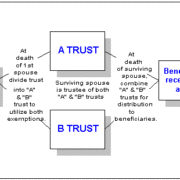
For Tax and Estate Planning purposes, as a married couple, maximize the use of your Federal Estate Tax Exemptions through the utilization of an AB Trust.

There are two vehicles available in which to set up an AB Trust

  • Living Will and Last Testament
  • Revocable Living Trust

The “A Trust” also referred to as the

  • Marital Trust
  • Marital Deduction Trust
  • QTip Trust

The “B Trust” is also known as the

  • Family Trust
  • Bypass Trust
  • Credit Shelter Trust

In 2011, the Federal Estate Tax Exemption   was made transferrable between married couples.  Should one pass away in 2011 or after, their entire Federal Estate Tax Exemption is not needed to avoid Estate Taxes.

If you are on your second, third, or additional marriage and have different beneficiaries, it is in your best interest to explore the benefits of the AB Trust.

The AB Trust can only function if you secure them while both spouses are alive. Don’t put off securing this beneficial part of your estate and tax planning as once you become a widow or widower, it is too late.

Below is an example of how the AB Trust works to your benefit:

For more information on setting up an AB Trust as part of your Estate and Tax Planning, contact Daniel A. Baron of Baron Law to maximize your Federal Estate Tax savings upon your passing. Contact us today at 216-573-3723.