
Baron Law LLC

Estate Planning – Protecting your Children Through Testamentary Trusts

From Cleveland, Ohio Estate Planning Attorney Dan Baron:

Estate planning attorneys will tell you that testamentary trusts are a great way to protect your children and plan for your estate.  Below are 10 things to know about testamentary trusts and how they might fit into your estate plan.  To learn more, contact Cleveland, Ohio estate planning attorney Dan Baron at Baron Law LLC.

  1. What is a testamentary trust?

A testamentary trust is a trust usually coupled with your last will and testament.  Contrary to many living trusts, a testamentary trust is revocable and will not take effect until you die.  The trust provides for the distribution of all or part of an estate and often proceeds from a life insurance policy held on the person establishing the trust.   You can have more than one testamentary trust in your will.

  1. Why choose a testamentary trust?

Most often a testamentary trust is used to protect your children.  For example, if husband who has a will dies in an automobile accident, his estate would pass to his wife.  However, if both husband and wife are die in the accident, leaving their two minor children behind, a simple will will not provide a plan for the estate. Thus, a testamentary trust may provide guidelines as to how the estate is passed to their children.   There are other trusts to consider.  Contact your estate planning attorney to learn more.

  1. How do you create a testamentary trust?

As mentioned above, the most common way in Ohio to create a testamentary trust is to include the necessary language in your will.  The creator of the trust (known as the “settlor”) dedicates a Trustee who then administers trust.  For example, in the event both spouses die, the trust might make the estate pass to their children at the age of 18.  Or, the estate might pass in the even one of the kids gets married.  It is recommended that an estate planning attorney create your trust.

  1. When is a testamentary trust created?

Unlike living trusts, the money is not distributed automatically.  Many people believe that testamentary trusts avoid probate.  However, there still are some probate considerations that are involved.  In Ohio, typically a testamentary trust begins at the completion of the probate process after the death of the person who has created it.  It is recommended that an estate planning attorney help guide you through setting up the trust.

  1. What is the term?

A testamentary trust lasts until it expires, which is provided for in its terms. Typical expiration dates may be when the beneficiary turns 25 years old, graduates from university, or gets married.

  1. How is the probate court involved?

As mentioned above, a testamentary trust will not automatically take effect.  Before the creator dies,  the probate court checks up on the trust to make sure it is being handled properly.  Once the creator dies, the beneficiaries of the estate should contact an estate planning attorney to carry out the trust.

  1. Who can be the trustee of a testamentary trust?

Anyone can be a Trustee for a testamentary trust.  However, it is recommended that the Trustee be someone that the creator trusts.  The Trustee will have great responsibility in administering the deceased’s wishes.

  1. Does the trustee have to honor the terms set out for expenditures in the will?

It depends.  Ultimately it is up to the Trustee to determine whether a certain act or time has occurred in order to distribute the estate.  Some of these events are very easy to figure out.  For example, if the trust provides that the estate be distributed upon a marriage, that event is easy to determine.  Conversely, if the trust provides that a certain dollar amount be distributed upon a child “finding a good job,” it becomes more subjective for the Trustee.  Thus, it’s imperative to hire a qualified estate planning attorney to help draft a will or trust.

  1. When can I opt out of a trust?

Generally, if the person’s estate is small in comparison to the potential life insurance proceeds or other amounts that will be paid to the estate at death, a testamentary trust may be advisable.

  1. How much does it cost to set up a testamentary trust?

It is generally inexpensive to set up a will with a testamentary trust.  In most cases, attorney Dan Baron at Baron Law LLC can set up a testamentary trust for less than $1,000.  If the estate plan is more complicated, the legal fees may be higher.  If you are interested in setting up a trust or estate plan, contact a Cleveland, Ohio estate planning attorney.  Call Baron Law LLC today at 216-573-3723.  You will speak directly with an attorney who can help with your estate planning needs.

wills and trusts attorney

How Does a Minimum Required Distribution Affect My Retirement?

Cleveland, Ohio Estate Planning Attorney

If your retirement portfolio contains a Simple Employee Pension (“SEP”), or Simple IRA, you need to know how the minimum distribution system works.  Cleveland, Ohio estate planning attorney Dan Baron provides the following remarks.

One major attraction to IRA’s and other estate planning tools is the ability to accumulate funds inside the plan on a tax-deferred basis. The minimum distribution rules dictate when this tax-sheltered accumulation must start coming out of a retirement plan, and, when they end.  Congress enacted the minimum required distribution rules to compel annual distributions from your retirement plan beginning typically at age 70 ½.  Estate planning and tax attorneys need to know the minimum required distribution rules because these rules set the outer limits on plan accumulations; moreover, failure to comply with rules results in penalties.

Is Your Retirement Plan Subject to the Rules?

Minimum required distributions apply to “Qualified Retirement Plans.”  IRA’s and 403(b) plans fall under the rules of qualified retirement plans.  However, Roth IRA’s are subject to the IRA minimum distribution rules only after the participant’s death.

Timing of a Minimum Required Distribution

If your retirement plan contains one of the above mentioned funds, there are many things to understand.  First, the starting point for lifetime required distributions is approximately age 70 ½ (or upon later retirement in some cases).  The starting point for post-death distributions is measured from the participant’s death.  Once the distributions start, the beneficiary must take distributions no later than December 31.  However, there are several exceptions to this rule including the “5 year exception” and rollovers.  Contact a tax attorney or estate planning attorney to learn more.

How is the Minimum Distribution Determined?

Each year’s minimum required distribution is determined by dividing the prior year-end account balance by a factor from an IRS table.  The amount is computed by dividing an annually-revalued account balance by an annually-declining life expectancy factor.  Taking more than the required amount in one year does NOT give you a credit you can use to reduce distributions in a later year.  Further, the distributions you elect cannot exceed 100 percent of the account balance.  Contact Cleveland, Ohio attorney Dan Baron to learn more on how this minimum distribution affects your retirement plant.

As you can see, there are numerous rules that affect your retirement and taxes.   Contact a Cleveland, Ohio attorney who can help you understand more about minimum required distributions or other estate planning rules.  Cleveland, Ohio estate planning Dan Baron can help you with your tax planning and estate planning goals.  Contact Cleveland, Ohio attorney Dan Baron at 216-573-3723.


Business succession plan

Creating a Business Succession Plan – Cross Purchase Agreements

Creating a Business Succession Plan – Cross Purchase Agreements

Whether you’re planning for retirement or tragedy, having a business succession plan is imperative for business owners.  Big business or small, planning for the financial stability of your partners and employees can mean the difference between business as usual and leaving your spouse bankrupt.   Moreover, understanding the value of your business can affect your decision to sell, retire, or leave a legacy.  Cleveland, Ohio estate and business planning attorney Dan Baron has the following remarks to help you secure your financial future.

One way to create a succession plan is through a “cross purchase agreement.” Two concepts stand at the root of all cross-purchase buy-sell agreements: protection and fairness. A surviving business owner wants to be protected from interference by outsiders when a co-owner dies. Concurrently, a business owner wants to assure fair treatment of his or her heirs in the event of death.

Step One – Choose a Successor

Unless you’re selling your business – where you would normally sell to the highest bidder – picking a successor isn’t easy.  Many factors determine whether a succession plan is necessary and sometimes it can be as easy as passing the business down through a family member.  When choosing a successor, there may be several partners or family members from which the owner will have to choose, each with various strengths and weaknesses to be weighed and evaluated.  In this case, lasting resentment by some or all of those not chosen may result, no matter what choice is ultimately made.  Outside of a family business, partners who do not need or want a successor may simply sell their portion of the business to their partners in a buy-sell agreement. Talk with a Cleveland, Ohio estate planning or business succession attorney to learn more.

Step Two – Evaluate the Value of the Business

As mentioned, your succession plan may be as simple as selling it off.  But no matter whom the intended successor may be business owners must establish a set dollar value for the business, or their share of it. This can be done via appraisal by a certified public accountant (CPA) or by an arbitrary agreement between all partners involved.  Tax attorneys and business succession attorneys may also assist in the business evaluation process.  Estate planning lawyers and accountants use various metrics for evaluation business including sales, stock value, liquidity, profits, reoccurring contracts, EBITDA (Earnings before Interest, tax, depreciation, and amortization), cash flow, and more.   In addition, your estate planning attorney may evaluate your business using a number of other methods including asset based or income based evaluations.  For corporations, where the portion of the company consists solely of shares of publicly traded stock, the valuation of the owner’s interest may be determined by the stock’s current market value.

Step Three – Cross Purchase Agreements

A cross-purchase agreement is a tool used by business owners to assure that “business as usual” continues if co-owner dies. Like an entity or stock redemption agreement, the cross-purchase buy-sell agreement stipulates that:

  • A deceased owner’s estate must sell the business interest to surviving owners, and
  • The surviving owners will buy that interest.

There are no exceptions—the estate must sell and the survivors must buy.

Creating a cross purchase agreement is commonly used a usually starts with creating a life insurance policy. Once a set dollar value has been determined for the business, life insurance is purchased on all partners in the business. Then, in the event that a partner passes on before ending his relationship with his partners, the death benefit proceeds will be used to buy out the deceased partner’s share of the business and distribute it equally among the remaining partners.

A cross purchase agreement is structured so that each partner buys and owns a policy on each of the other partners in the business.  Each partner functions as both owner and beneficiary on the same policy, with each other partner being the insured; therefore, when one partner dies, the face value of each policy on the deceased partner is paid out to the remaining partners, who will then use the policy proceeds to buy the deceased partner’s share of the business at a previously agreed-upon price.

Example: How a Cross-Purchase Agreement Works

Let’s say for example that there are three partners who each own equal shares of a business worth $3 million, so each partner\’s share is valued at $1 million.  The partners are getting older and want to ensure that the business is passed on smoothly in the event one of them dies. Thus, they enter into a cross-purchase agreement. The agreement requires that each partner take out a $500,000 policy on each of the other two partners. Now, if one of the partners dies, the other two partners will each be paid $500,000, which they must use to buy out the deceased partner\’s share of the business.

One limitation to be noted here is that, for a business with a large number of partners (five to 10 partners or more), it becomes impractical for each partner to maintain separate policies on each of the others. There can also be substantial inequity between partners in terms of underwriting and, as a result, the cost of each policy.

Cross purchase agreements are just one of many ways to ensure a business’s legacy.  For more information on estate planning or business succession, contact Cleveland, Ohio attorney Daniel A. Baron at Baron Law.  Contact a lawyer today by calling 216-573-3723.  You will speak directly with an Ohio attorney who can help you with all your estate planning needs.

lawyer in cleveland ohio

What is a Charitable Remainder Trust?

Unique Estate Planning Methods to Secure a Lifetime of Income, Save Taxes, & Benefit the Community

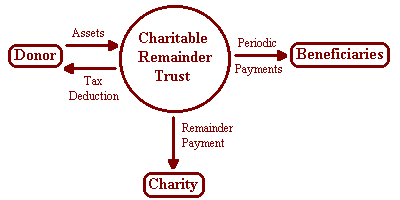
Most people planning for their retirement have a misconception that charitable giving is only for the wealthy.  However, there are several estate planning tools that can benefit your favorite charity while also earning you steady stream of income.  One of these tools is known as a charitable trust remainder, or “CRT.”  A CRT lets you convert a highly appreciated asset like stock or real estate into a lifetime of income. It reduces your income taxes now and may also reduce your estate taxes when you die. When the assets are sold, creators of the CRT escape the ever-daunting capital gains tax.  But best of all, a charitable remainder trust allows you help one or more of your favorite charities.

How does a CRT work?

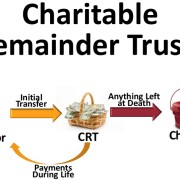
Creators of a charitable remainder trust transfer an appreciated asset into an irrevocable trust.  It’s important to have assets that appreciate in value in order for a CRT to work effectively.  Assets that have little or no appreciation may be better off going into a charitable lead trust or charitable remainder annuity trust.  In any event, when you transfer an appreciating asset into the charitable remainder trust, it removes the asset from your estate.  Thus, no estate taxes will be due on it when you die.  Most importantly, you also receive an immediate charitable income tax deduction.

After the trust is created, the Trustee sells the asset at full market value.  Again, after the sale you will not pay capital gains tax.  The money is then reinvested and the proceeds from the reinvestment go to you for the rest of your life.  When you die, the remaining trust assets go to the charity(ies) you have chosen.  Hence the name charitable remainder trust.

attorney in cleveland, ohio

Cleveland, Ohio estate planning attorney

Example Using a Charitable Remainder Trust

Let’s say for example that Gail Giver (age 63) purchased some stock for $100,000.  It is now worth $500,000.  She would like to sell it and generate some retirement income.  If she transfers the stock to a CRT, Gail can take an immediate charitable income tax deduction of $90,357. Because she is in a 35% tax bracket, this will reduce their current federal income taxes by $31,625.

The trust is exempt from capital gains tax so when the trustee sells the stock for the full $500,000, all of the money is available for reinvestment.  Assume that the assets will accumulate 5% of annual growth and Gail is expected to live for another 26 years.   Using this information, that produces $25,000 in annual income which, before taxes, will total $650,000 over Gail’s lifetime. And because the assets are in an irrevocable trust, they are protected from creditors.

Example Not Using Charitable Remainder Trust

What would happen if Gail sold the assets and reinvested them herself? If Gail sells the same $500,000 in stock, she would have a gain of $400,000 (current value less cost) and would have to pay $60,000 in federal capital gains tax (15% of $400,000).  That would leave her with $440,000.

If she re-invested and earned a 5% return, that produces $22,000 in annual income.  Using the same life expectancy and 5% annual income as mentioned before, this would give her a total lifetime income (before taxes) of $572,000.   However, because Gail Giver still owns the assets in her name, there is no protection from creditors.  Looking back, without the use of a CRT, she loses $78,000 in income than if she had created a charitable remainder trust.

Comparison of Income after Sale

Without CRT       With CRT

Current Value of Stock                  $ 500,000             $ 500,000

Capital Gains Tax*                           – 60,000                0

Balance To Re-Invest                      $ 440,000             $ 500,000

5% Annual Income                          $ 22,000                $ 25,000

Total Lifetime Income                    $ 572,000             $ 650,000

Tax Deduction Benefit**              $ 0                          $ 31,625

*15% federal capital gains tax only.

(State capital gains tax may also apply.)

**$90,357 charitable income tax deduction times 35% income tax rate.

Are there other options? Of course!  Another charitable estate planning tool is called the charitable lead trust, or CLT.  A CLT is the reverse of a CRT.  This revocable trust provides income to a charity for a set number of years, after which the remainder passes to the donor’s heirs or beneficiaries.  The CLT is a good choice for those who don’t need a lifetime of income from certain assets.  The trust is often structured to get an income tax deduction equal to the fair market value of the property transferred, with the remaining interest valued at zero to eliminate a taxable gift.  Contact an estate planning attorney to learn more about charitable lead trusts.

Finally there is also a trust called the pooled income fund (PIF).  Pooled income funds are trusts maintained by public charities. The trust is set up by donors who contribute to the fund.  Just like a CRT, the donor receives income during his or her lifetime.  After the donor’s death, control over the funds goes to the charity. The biggest benefit to a PIF is that contributions qualify for charitable income deductions as well as gift and estate tax deductions.  Talk with an estate planning attorney to learn more.

As you can see, there are a number of different ways to give to your favorite charity while also planning for a secure retirement. This blog is meant for information purposes only and should not be construed as legal advice.  Contact an estate planning attorney at Baron Law, LLC for a free consultation.  Baron Law, LLC is your Cleveland, Ohio estate planning attorney. Contact Cleveland, Ohio attorney Dan Baron today at 216-573-3723

cleveland ohio attorney

Building a Charitable Contribution in your Estate Plan

Estate Planning Charitable Donations

Have you ever considered incorporating a charitable donation into your estate plan?   Aside from the tax benefits, including charitable giving into your estate plan is a wonderful way to extend your legacy and show your generosity.  And contrary to public belief, charitable giving in your estate plan is not just for the very wealthy.   Through an estate planning attorney, there are several good ways to provide for your family while also giving to your favorite causes.

  1. Charitable Contributions through Your Will

The easiest and least complicated way to include a charitable contribution in your estate plan is through your will.  The amount you charitably contribute won’t reduce your income taxes, but it may decrease your taxable estate.  In addition, this may potentially increase the amount you’ll be able to leave to your heirs.  Talk with an estate planning attorney to learn more.

  1. Charitable Contributions through Your Retirement

You can also contribute to your favorite charity by donating a portion of your retirement account. Donating a retirement account is tax-effective and pretty straightforward.   A donor must simply designate the charity as the beneficiary on your account to receive the tax benefit.  Charities are exempt from both income and estate taxes.  Thus, the charity can receive 100% of the account’s value while your children or heirs receive their portion of the estate through non-retirement assets.  Consult with an estate planning attorney to learn more.

  1. Split-interest gift

Another way to make a charitable contribution is through a split-interest gift.  Through a split interest gift, you can donate assets to a charity but may also retain some of the benefits of holding those assets.  Here, the donor opens and funds a trust in the charity’s name and receives a charitable income tax deduction at the time of transfer.  Just like with other trusts, here the donor retains some rights to the property and may be able to avoid capital gains on the assets transferred.  Talk with an estate planning attorney to learn more about split-interest gifts.

Some ways to provide split-interest gifts include:

  • Charitable remainder trust (CRT): A CRT is an irrevocable trust that provides either a fixed payment or a fixed percentage to the donor (or other beneficiary) every year.  The term of the trust can for the life of the donor or a set number of years.   At a minimum, the donor must take annual payments from the trust no less than 5% but no more than 50% of the property’s fair market value.  At the end of the term, the remainder goes to the designated charity.  To maximize payments during the lifetime of the donor, the trust should appreciate value while receiving payments in the form of a percentage.   In contrast, if the trust will not appreciate in value, you’re better off receiving a fixed payment each year. Consult with an estate planning attorney to learn more.
  • Charitable lead trust (CLT): A CLT is the reverse of a CRT.  This revocable trust provides income to a charity for a set number of years, after which the remainder passes to the donor’s heirs or beneficiaries.  The CLT is a good choice for those who don’t need a lifetime of income from certain assets.  The trust is often structured to get an income tax deduction equal to the fair market value of the property transferred, with the remaining interest valued at zero to eliminate a taxable gift.  Contact an estate planning attorney to learn more about charitable lead trusts.
  • Pooled income fund (PIF):  Pooled income funds are trusts maintained by public charities. The trust is set up by donors who contribute to the fund.  Just like a CRT, the donor receives income during his or her lifetime.  After the donor’s death, control over the funds goes to the charity. The biggest benefit to a PIF is that contributions qualify for charitable income deductions as well as gift and estate tax deductions.  Talk with an estate planning attorney to learn more.

Charitable Giving is not just for the Wealthy.

There is a misconception that charitable giving is just for the wealthy; however, this is far from true.  Many people give to their alma mater or local church.  The amount does not need to be in the tens of thousands.  In fact, many people give smaller amounts by simply adding the charity in their will.  This blog is not meant to provide legal advice and is for informational purporses only.  For more information regarding wills, trusts, or charitable giving, contact Cleveland, Ohio law firm Baron Law, LLC.  Baron Law is your estate planning law firm in Cleveland, Ohio.  Call today for a free consultation at 216-573-3723.

Cleveland, Ohio attorney

Can a Beneficiary Force a Trustee to Provide Information Contained in a Trust?

Cleveland, Ohio Estate Planning Attorney

Can a Beneficiary Force a Trustee to Provide Information Contained in a Trust?

In addition to the blog below, do you have questions regarding estate planning or trust administration?  Call Cleveland, Ohio law firm Baron Law LLC.  An attorney at Baron Law will be able to assist you and provide legal advice for all your wills and trust needs.

If you’re resident of Ohio, then as a beneficiary, you have a right to see a trust and can force the trustee to provide you a look.  Under Ohio law, the Trustee is obligated to give a copy of the trust to beneficiaries if they ask for it.  Cleveland, Ohio estate planning attorney Daniel A. Baron points to Ohio Revised Code Section 5808.13 which provides in part

“A trustee shall keep the current beneficiaries of the trust reasonably informed about the administration of the trust and of the material facts necessary for them to protect their interests. Unless unreasonable under the circumstances, a trustee shall promptly respond to a beneficiary’s request for information related to the administration of the trust.”

The Ohio statute further provides that a trustee must:

“Upon the request of a beneficiary, promptly furnish to the beneficiary a copy of the trust instrument. Unless the beneficiary expressly requests a copy of the entire trust instrument, the trustee may furnish to the beneficiary a copy of a redacted trust instrument that includes only those provisions of the trust instrument that the trustee determines are relevant to the beneficiary’s interest in the trust. If the beneficiary requests a copy of the entire trust instrument after receiving a copy of a redacted trust instrument, the trustee shall furnish a copy of the entire trust instrument to the beneficiary. If the settlor of a revocable trust that has become irrevocable has completely restated the terms of the trust, the trust instrument furnished by the trustee shall be the restated trust instrument, including any amendments to the restated trust instrument.”

Put more simply, if you’re a beneficiary to a trust, you simply need to ask and you will be provided a copy of the trust.  Conversely, if you’re the Trustee and receive one of the requests listed above, you likely have to comply.  Beneficiaries having problems getting information from a Trustee should refer to the above statute.  Trustees who fail to respond risk being removed as the Trustee.  In addition, if there is a law suit, the attorney’s fees would be taken out of the trust, thus reducing the value to all beneficiaries.

This blog is for informational purposes only and is not intended as legal advice.  If you need an estate planning attorney, trust attorney, wills attorney, or other Cleveland, Ohio attorney contact Baron Law LLC at 216.573.3723.  You will speak directly with an Ohio attorney who can assist you with your legal needs.

husband and wife signing trust document with lawyer

Will Vs. Trust: Which Do I Need?

Learn the main differences between wills and trusts and how an estate planning attorney can help you select the right type of each that will work together to accomplish your goals.