
lawyer estate planning cleveland, ohio

Long Term Care – Paying for the Nursing Home

Cleveland, Ohio estate planning attorney, Daniel A. Baron, offers the following information on the paying for Long Term Care and incorporating it into your Estate Planning:

Baron Law Estate Planning Attorney

There are misconceptions regarding Long Term Care and who is responsible for paying for any care. This information may be used for informational purposes only.  For more information, or to speak with an experienced Medicaid planning attorney, contact Dan Baron at Baron Law.

Medicare:

In Ohio, Medicare only pays for Long Term Care IF you require rehabilitative care or skilled services. Skilled services are:

    • If you are in a nursing home, the maximum number of days Medicare pays for is 100; however the average covered stay is much shorter at 22 days
    • If you are able to stay at your own home, Medicare pays for skilled home health care or other skilled in-home services but only for a short period of time
    • Medicare does not pay for any non-skilled assistance for your ADL’s (Activities of Daily Living) which tend to make up the majority of in home Long Term Care.
    • You are solely responsible for paying for Long Term Care services provided to you that would not be covered by any other public or private insurance programs. For additional information regarding Medicare, please visit https://www.medicare.gov/


Medicaid:

  • Pays for the largest portion of Long Term Care services, provided your income meets the states minimum eligibility requirements.
  • Medicaid will cover your costs depending on how much assistance you need with Activities of Daily Living.
  • There are numerous considerations when considering Medicaid and it’s important to talk with a Medicaid planning attorney.  To learn more about some considerations, visit this Medicaid Considerations Article.
  • There are other federal programs available for specific populations and circumstances that may pay for Long Term Care
    • Older Americans Act
    • Department of Veterans Affairs

Private Health Insurance

  • Employer sponsored or private health insurance, cover the same kinds of limited services as Medicare
  • If your carrier does cover Long Term Care, typically it will only be for skilled care but only short term

Other Private Payment Options can include

For more information on reviewing your goals for Long Term Care as part of your Estate Planning, contact Daniel A. Baron of Baron Law at 216-573-3723.

cleveland, ohio attorney

When Should You Start Planning For Long Term Care?

Cleveland, Ohio estate planning attorney, Daniel A. Baron, offers information on when you should start planning for Long Term Care and including this as part of your Estate Planning:


When should you start planning for Long Term Care? If you are under 50, the answer is – “there is no time like the present”.  Approximately 70% of today’s population will need some sort of Long Term Care sometime within their lifetime.

What you should know about planning for the future

When in later years and you are in need of skilled services or should you require rehabilitation services, Medicare pays for this type of long term care. Unfortunately, Medicare does not pay for any non-skilled assistance with your ADL’s (Activities of Daily Life) or IADL’s (Instrumental Activities of Daily Living) which tend to make up the majority of Long Term Care.

You should start thinking now about how you are going to pay for Long Term Care as it is much more expensive than you might think.

There are a number of ways you can use to pay for your long term care. Being 50 of under, this may be the best time in your life financially to start planning for long term care, rather than after you have had a serious illness or become disabled.

You may also consider securing an Advance Directive which informs your family and other loved ones how you would like your medical matters handles, should you become incapacitated and are no longer able to communicate your wishes of your medical care.

For more information on reviewing your goals for Long Term Care as part of your Estate Planning, contact Daniel A. Baron of Baron Law today at 216-573-3723.

AN AB Trust – What are the benefits for your estate?

Cleveland, Ohio estate planning attorney, Daniel A. Baron, offers information on an AB Trust and the benefits realized from including this as part of your Tax and Estate Planning:

For Tax and Estate Planning purposes, as a married couple, maximize the use of your Federal Estate Tax Exemptions through the utilization of an AB Trust.

There are two vehicles available in which to set up an AB Trust

  • Living Will and Last Testament
  • Revocable Living Trust

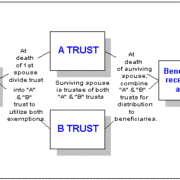
The “A Trust” also referred to as the

  • Marital Trust
  • Marital Deduction Trust
  • QTip Trust

The “B Trust” is also known as the

  • Family Trust
  • Bypass Trust
  • Credit Shelter Trust

In 2011, the Federal Estate Tax Exemption   was made transferrable between married couples.  Should one pass away in 2011 or after, their entire Federal Estate Tax Exemption is not needed to avoid Estate Taxes.

If you are on your second, third, or additional marriage and have different beneficiaries, it is in your best interest to explore the benefits of the AB Trust.

The AB Trust can only function if you secure them while both spouses are alive. Don’t put off securing this beneficial part of your estate and tax planning as once you become a widow or widower, it is too late.

Below is an example of how the AB Trust works to your benefit:

For more information on setting up an AB Trust as part of your Estate and Tax Planning, contact Daniel A. Baron of Baron Law to maximize your Federal Estate Tax savings upon your passing. Contact us today at 216-573-3723.

Medicaid Planning

Applying for Medicaid? Here’s What You Need to Know About Activities of Daily Living vs. Instrumental Activities of Daily Living

Cleveland, Ohio estate planning and elder law attorney, Daniel A. Baron, offers the following information on the definition of ADL’s and IADL’s and how to plan on Long Term Care as part of your Estate and Medicaid Plan: As we are all well aware, there is only one alternative to aging. If you are fortunate […]

Estates Planning Lawyer

I Recently moved to Ohio from another State? Do I Need To Update My Power of Attorney?

Cleveland, Ohio estate planning attorney, Daniel A. Baron, offers the following helpful answers to Powers of Attorney:

What If I have a Power of Attorney From another state?

Most Powers of Attorney signed in other states will be recognized in the other states. A Power of Attorney used to convey title to real estate, typically must be signed, dated, witnessed by two people, and “acknowledged” or notarized by a notary public or court official.  The state laws will govern who is authorized to take “acknowledgments”.  The practical question is not whether the Power of Attorney is valid, but whether a financial institution will honor it.  Also, if the document refers to statutes from another state, you may have to provide a copy of those statutes.

The law may vary in the state where you signed your Power of Attorney versus the state in which you now reside. Even if the document lists the same or similar powers, the meanings may be different  in the two states.  Also, many states have different statutory protections for people signing a Power of Attorney.

Suffice it to say, it may be in your best interest, if practicable, that you have new Powers of Attorney executed.


Do I need to get a new Power of Attorney if I move to a different state?

When moving to a different state, you should always consult a local attorney to see whether your Power of Attorney will be as you intended.

In some states, a Power of Attorney is not “durable” unless it is “recorded”. Recorded means filed with local government.  In addition, there may be special rules about how it is revoked.  It would behoove you to check with a local attorney.

Again, it may be in your best interest, if practicable, that you have new Powers of Attorney executed.


A Power of Attorney is only one of the many parts to a comprehensive estate plan. For information regarding living wills, trusts, power of attorney, or a pour-over will, or further questions on Powers of Attorney, contact Daniel A. Baron of Baron Law to arrange a meeting at 216-573-3723.